BartBlog

July 16, 2010

Cold & Hard: Spending the night in Arnieville

Filed under: Uncategorized — Tags: , , , — Jane Stillwater @ 4:11 pm

Mark Twain’s autobiography is finally getting published — almost one hundred years to the day after he wrote it. And from what I can tell after reading the book’s advance reviews, Twain was also one hundred years ahead of his time, having apparently come back from the grave just in time to give us a much-needed warning about being wary of America’s oligarchs and to nail today’s corporatists for what they are — greedy bastards.

And I think that it was also Mark Twain who said, “The coldest winter I ever spent was a summer in San Francisco.”

Me and my daughter Ashley stopped by Arnieville last night, where disabled people are camping out in protest of Governor Schwarzenegger’s callous cuts to their home-care workers’ salaries. Arnieville has been set up on a traffic island on Adeline Street near Russell in Berkeley, right down the street from my apartment. “How’s it going?” I asked some folks in wheelchairs who were sitting in front of the campsite eating dinner and chatting about stuff.

“It’s going okay, considering the horrible mess that our state’s finances are in,” replied a blind woman. “And we’ve going to try to stay here until the State of California actually manages to come up with a budget.” Yikes! That could take for-EVAH.

“It’s not so bad here during the day,” said another woman in a wheelchair, “but at night it gets a bit heavy-duty.” I can imagine — you can’t just take a hot bath, turn off the lights and pop into bed here. No pre-bed glass of warm milk and bedtime stories either. Plus you can’t even turn off the street lights — although the City of Berkeley has been kind enough to not run the sprinklers at 4 am. And the automobile, truck and bus traffic on Adeline Street goes on all night long, just five feet from your head.

“We do have a security team that takes turns keeping watch so it’s fairly safe here, but sometimes I’m the only woman at night and it gets a bit gender-heavy on the masculine side. I wish that we had more women camping out,” looking directly at me as she said this, hint hint. She also wished that the campers had more monetary donations so that they could pay for their wheelchair-accessible PortaPotty. That’s probably not covered in the state budget either.

Then I went home and got to thinking. I gots bad knees. I’m 21% disabled. Those people are doing this for my sake too. I should be out there camping with them! So I went back this evening and asked if I could stay too. “You can borrow my tent,” said my daughter Ashley who used to be a Girl Scout.

And I could wear my warm flannel nightgown and my bunny slippers!

But then, as we sat there chatting with the protesters, fog started rolling in from across the bay, the temperature dropped 20 degrees and I started to chicken out. “And besides, Big Brother 12 is on TV tonight,” I whined. So much for roughing it for a good cause.

So. Will I spend the night in Arnieville tonight? Or will I let people who are even physically weaker than me end up doing the heavy-lifting for all of us? Will I protest the injustice of having so much of California’s tax money go to large corporations and rich people but not to the people who actually need and deserve it — or will I just stay home snug in my bed and turn a blind eye to injustice like most other Californians seem to be doing?

Or will I bite the bullet, haul my sleeping bag out of the closet, be brave like the disabled people down at Arnieville (and Mark Twain), and nail these corporatists for what they really are — greedy bastards.

PS: Yes, I finally did get up enough nerve to actually go camp out. Remember those baby chickens that I got at the county fair last week? Well, last night I looked at them and they looked at me and I swear I actually heard one of them saying, “And you’re the one that’s calling ME a chicken?” So I figured that I’d better put my money where my mouth is.

“You can sleep in that yellow tent over there, said a member of the security team when I arrived (chickenless) at 1:00 am in the morning last night, pillow and blanket in hand.

“And how’s progress on the state budget coming along?” I asked. Not so good. And camping out didn’t go so well either. The ground, like the Governator, was cold and hard too. Plus I’d forgotten my flannel nightgown and bunny slippers. I don’t see how these disabled people do it.

Last night I slept in a yellow tent next to an empty wheelchair, some crutches and an artificial leg.

PPS: Country Joe McDonald is giving a free concert at Arnieville on Saturday July 17, 2010 at 3:00 pm. Please come to the concert. Please support Arnieville. Please donate air mattresses!

PPPS: You can also donate $$$$ to keep Arnieville alive (and representing other Californians besides just the oligarchs) by going to their website at http://arnieville.org/.

PPPPS: Does anybody out there want to adopt any baby chickens? Ones that I (almost) promise won’t talk back?

BP caps leaking well, but industry experts say it may not be a permanent fix

Filed under: Uncategorized — Greg in cheeseland @ 4:04 am

Author’s note: Firstly, BP wouldn’t be taking the time and effort with this new cap just before the relief well is about to be complete if they did not know that the relief well has a very little chance of being successful. Even if the relief well manages to intersect the main well, the sandblasting effect may have eroded the main well enough that it cannot be plugged with drilling mud and cement. If the pressure from the well blew out the mud from the top kill, why would anyone think the same thing would not happen deeper down, where the pressure is just as great is not more? Secondly, there have been numerous reports of additional leaks in the well bore itself and from fissures in the ocean floor near the site. Installing this new cap will confirm that, and if that is the case, neither the cap nor the relief wells will stop the leak. Thirdly, if this cap actually does work it would provide a means to accurately measure how much oil has been flowing into the Gulf, which most scientists know is far more than BP or the feds have admitted. That is crucial in determining how many billions of dollars BP will pay in fines. Do you think BP really wants anyone to know that? Lastly, the only thing BP has a good record with in this disaster is BS. Why would anyone think that will change now?

Excerpt:
BP announced yesterday that at 2:25 PM CST, a cap placed over the leaking well had stopped the flow of oil into the Gulf of Mexico. While that is great news for everyone, some industry experts caution that it may not be a permanent fix.

As early as May 31, after the top kill procedure failed, a BP official admitted to the Washington Post that “We discovered things that were broken in the sub-surface.” He said that mud was making it “out to the side, into the formation.” The official said he could not describe what was damaged in the well.

According to industry experts, if that is the case, the integrity tests with the new cap could make matters worse. Don Van Nieuwenhuise, director of geosciences programs at the University of Houston, told CNN today, “We don’t know if there are significant leaks deep in the well. There’s a couple of weak points at 9,000 feet, and one at 17,000 feet, that they might be particularly interested in looking at and watching in the seismic.”

Any additional leaks in the well bore below the surface could cause the well to blow out again during integrity testing, and make it more difficult, if not impossible, to plug with relief wells. Recently-retired Shell Oil President John Hofmeister made a similar point:

I think the fundamental issue… is there are serious concerns about the integrity of the casing that is the well itself. And that by putting the cap on and doing the stress tests… that the integrity of the steel is insufficient to hold the pressure of the well. And if you lose the casing it’s game over. It’s like having a volcano on the bottom of the sea. If you lose the casing and oil starts coming up on the outside of the casing you cant stop it. There’s nothing you can do that would stop it…other than implode the well. There are many in the industry that feel the casing must have been damaged because of the power of that well, the pressure of that reservoir.

Another oil industry expert, Rob Cavner, who has been correct about virtually everything regarding the disaster thus far, previously explained that there is damage in the oil well beneath the seafloor. He also says that he is worried that the well integrity test could further damage the well bore and could blow out the entire well even further (see video here).

Cavner believes BP may have an ulterior motive in capping the well instead of just completing the relief well: “While they have every incentive to get the well killed, BP also has every incentive to not capture 100% of the well flow until they do,” Cavnar wrote last week at Huffington Post. “As soon as they do capture all the flow, then a real, measurable number will be in front of the public, and that’s the last thing BP wants, since that number will then be used to extrapolate environmental damage, hence per barrel fines that will likely run to the tens of billions anyway.”

Coast Guard Adm. Thad Allen’s comment on CNN yesterday seems somewhat suspicious in light of Cavner’s allegation. He cautions: “This isn’t over” and talks about the cap as a temporary measure to be used for hurricanes. “It remains likely that we will return to the containment process… until the relief well is completed,” (see video here). So it looks like the plan is to go back to releasing the oil and letting it pump up to the surface.

Worse yet, there have been reports of additional leaks in the seabed miles away from the well, (see videos below). Rep. Ed Markey, Chairman of the Energy and Environment Subcommittee, addressed that issue in a letter to BP asking: “Do any or all of these events indicate that oil and gas could be flowing from somewhere other than the target reservoir?” If he has received an answer, it has not been publicized. If the answer is “yes,” then neither the new cap nor the relief wells will stop the flow of oil into the Gulf.

BP does not have a good record in terms of public disclosure. BP suspended the “top kill” operation for 16 hours because, according to numerous experts, it was creating more damage to the well bore. BP did not tell the media, local officials or the public that it had delayed the effort until long afterwards. Similarly, it took more than 5 hours for BP to publicly announce the delay of the well integrity test after the decision to delay was made.

Is the well integrity test a meaningless PR stunt or a ruse to hide the true scope of the leak, which is delaying completion of the relief wells, and failing to bring us any closer to permanently killing the oil gusher? Or is it a valuable tool to see if the well can be protected from further damage during a hurricane?

Only time will tell… Let’s continue hope for the best.

Read more, get links and video here: Madison Independent Examiner – BP caps leaking well, but industry experts say it may not be a permanent fix

July 15, 2010

Why Europe will never let Iran get bombed…

Filed under: Uncategorized — Tags: , , — Jane Stillwater @ 12:13 pm

Has Europe just been appointed Iran’s designated driver? Is Europe going to keep Iran from getting bombed? And, more important, can Europe take away America’s and Israel’s car keys as well? Yes, yes, and yes.

Let’s talk realistically here. The various corporatists and neo-cons who have seized control of the military decision-making processes in both America and Israel have been making a lot of strong noises lately to the effect that they really really want to attack Iran. Sober up here, guys! Get a grip. You seem to have carefully isolated yourselves — and also your backup crew of citizen right-wingers — from all too many of the realities and facts on the ground that are readily available to the rest of the world.

For instance, did you know that people in Europe view the Israel-Palestine situation from a very different perspective than most Americans do? Almost everyone in Europe has been pretty much disgusted by the American-backed Israeli neo-cons’ failed 2006 invasion of Lebanon, its brutal 2009 invasion of Gaza and its recent viscous attack on the internationally-sponsored humanitarian flotilla to Gaza.

Knowing this, what makes Israel’s and America’s corporatist decision-makers think that Europe (and also Russia, China, etc.) is going to welcome an invasion of Iran with open arms? Not gonna happen!

Further, by isolating and restricting our major media to the point where it mainly prints opinions that corporatists in Washington want to hear, Americans and Israelis may be cutting off their own noses in order to spite their face with regard to Iran.

At this point, the media war for America’s hearts and minds needs a serious reality check. Otherwise, Americans may find themselves once again swimming out into the deep end of the pool at their own peril — just like what happened in Vietnam, Afghanistan and Iraq.

Won’t someone please take our military-industrial complex’s car keys away! They may think that they are sober — but in reality they have drank far too much of the “Endless War” Kool-Aid and are in NO condition to drive. Europe knows this. But apparently we Americans do not.

It seems that if corporatists, neo-cons and right-wingers don’t like reality, they try to make it disappear. And the main difficulty with this approach to reality is that we the people are getting suckered into situations that we might normally avoid like the plague. However, trying to convince Europe, Russia, South America and Asia to go along with these war plans against Iran may turn out to be a hard sell indeed.

And there’s another major factor involved in this facts-on-the-ground equation as well — unlike Iraq and Afghanistan (and to some extent Palestine), many Europeans, Asians, etc. have actually BEEN to Iran.

Who the freak went to Iraq before Shock and Awe? Hardly anyone. Saddam Hussein’s Iraq was not exactly some hot new tourist destination. And tourists hardly ever went to Afghanistan — except for perhaps a few hippies with wanderlust back in the 1960s. But. What Americans and Israelis apparently don’t comprehend or understand is that Iran is a major tourist attraction — for both Europeans and Asians. Think Egypt and the pyramids. Think Taj Mahal. Iran is to Europe what the Grand Canyon or the Great Wall of China is to us. A major tourist hotspot!

So while a huge number of Americans still think that Iran is filled with sand and camel jockeys and harems, most Europeans and more than a handful of Asians have been there, done that. They know, for instance, that Tehran is the Paris of the Near East. They know that the ruins at Persepolis rival the ruins at Karnak. And they know that Estafan’s grand palaces and mosques can easily compete with the coliseum and Vatican in Rome. And Europeans flock to Iran by the tens of thousands annually.

Europeans have been there. Americans have not. You can tell Americans ANYTHING about Iran and they will believe it. You can’t tell Europeans diddly-squat about Iran — because they have actually been there themselves.

For this reason alone, I’m willing to bet the farm that Europeans will never let Iran get bombed.

PS: And I’ve been to Iran too. Here’s Part One of my report on the wonders of Iran. “Iran never disappoints.”

****

Innocents Abroad: On the Road in Iran
October 8, 2008: “I have no idea what to wear to Iran,” I whined. I’d heard stories of women actually being executed there for not covering themselves from head to toe.

“Don’t worry about that,” said an Iranian-American friend. “Just wear long sleeves, long dresses and a headscarf and you’ll be fine.” But I don’t even own any dresses. Crap. This is going to be like dressing up for a trip to the moon. I’m totally out of my cultural depth.

“It’s just not that big a deal,” said my friend. But it is. All I ever wear these days are jeans and T-shirts. Jeans and T-shirts. That’s it. “Jane, get a grip. Jeans are made of cloth. Dresses are made of cloth. Same difference. You’ll do fine.”

But still I worry. I’m not worried about going to Iran during a time-period where that idiot George Bush is threatening to bomb it and being there when the bunker-busters drop. And I’m definitely not worried about getting any tourist diseases over there. No, I’m all worried about clothes and I’m also worried about getting a ticket from the fashion police for looking like a dork.

“Jane,” said my friend, “you went on Hajj and spent a whole month in Mecca. You visited Afghanistan. You even stayed on in Palestine. And you loved every moment. You’ll like Iran as well.” Will I? I’m going to find out tomorrow. I’m leaving tomorrow for Tehran.

October 9, 2008: It’s 4:00 am in the morning, our jet plane is somewhere over Iceland, I just watched a re-run of a movie I saw last spring when I flew to China, I’m uber-tired and I’m stuck in a middle seat with no legroom – but other than that this has been a very smooth flight. I haven’t been reduced to total terror so far.

The man in the seat to my right – 35F – is from Monte Negro and he just gave me a capsulated rundown on the Serbo-Croatian war. “Serbs, Croats and Monte Negrans all speak dialects of the same language,” he added, “but the people from Kosovo speak Albanian, which is a language unto itself.”

“What’s Monte Negro like now?”

“We have a lot of beaches. It’s a tourist destination and we have hydropower and aluminum. Tito was in charge when I was a boy. There wasn’t all that much freedom of speech like there is now but we had excellent free education and healthcare.” Trade-offs.

The woman on my left – 35D – was from India and remembered the days before the partition. “Hindu and Urdu are also similar languages,” she said. I didn’t know that.

Both my seatmates had lived through civil wars. “I spent the entire duration of the Serbo-Croatian war in Russia,” said the Monte Negran, “and the United States.” Good thinking. Avoiding a war zone is always a good idea.

There’s a kind of fugue state generated by flying and I am now definitely in that zone. If I read any of what I wrote here later, will it make sense? Probably not.

After we landed in Frankfurt, a bus came out to our 747 and drove us for about a mile to the terminal, past a very long flight line. “How many wide-bodies do they have in this place!” I exclaimed to the Indian lady.

“Maybe 50?” Or more – all bearing the name “Lufthansa”. Some were being driven from place to place like they were cars. Others sat parked in long parking-lot lines, like they were waiting around for their owners to get back from the mall and drive them home. “Aren’t they pretty!” someone said. Yes.

Then I trundled off to my free Sheraton Hotel dayroom, soaked in a nice long hot bath and slept for five hours. Heavenly – except for the dream. The dregs of society were down by the waterfront planning a wedding. One woman-man had a tongue made of metal and the end of his-her tongue had rusted off. Eeuuww.

Meanwhile back on the plane to Tehran…. We saw a lot of cartoons. “Why are we watching children’s shows?” said a member of our group that I had met at the Frankfurt airport gate lounge while waiting for our flight.

“Because Iranians love cartoons.” Interesting. We watched Mickey Mouse, Donald Duck and the Little Mermaid. Since when does the Little Mermaid pass the dress code?

There were two wonderful babies on the plane. More and more, I’ve been noticing wonderful babies – of all races, cultures and creeds. Maybe I just started noticing wonderful babies because of my wonderful granddaughter – or maybe more wonderful babies are being born because there is a greater need in the world now for wonderful babies than there ever has been before. Perhaps they will all grow up and save the world.

We have one hour and eleven minutes before we arrive in Tehran. Is it time to start putting my headscarf on yet?

I met up with the rest of my tour group at Gate 22 of the Frankfurt airport. They all seem very nice – three younger women, several women my age and a middle-aged couple. There’s supposed to be one more man but I haven’t met him yet.

“Do you have a copy of the itinerary?” I asked one of the women my age.

“Sure. We’ll be flying to the northern part of Iran and then driving back down south.” Oh goodie! We’ll get to see a lot of the countryside and not just Tehran. “Yadz, Persepolis, Esfahan.” Tourist hotspots and famous archeological digs. Cyrus and Alexander were here. I may have accidentally stumbled onto the trip of a lifetime – besides Egypt of course…and maybe India. Manchu Picchu? The Potola in Tibet? Shut up, Jane.

“Ladies and gentlemen, we have a very important announcement,” said the stewardess. “All women are required to cover their heads so we ask you to put on headscarves before we land in Tehran.” So I ran to the toilet area to put on my long skirt and coat-dress — and the plane started rocking and the “return to seat” light started flashing and the stewardess kept saying, “Return to your seats,” and there I was, halfway in and halfway out of my costume and bouncing around the toilet compartment and muttering “Oh crap!”

But when I got back to my seat, the Iranian men I had befriended on the flight all smiled and cheered and I was a big hit – except for the man next to me who got all nauseous and rang for the stewardess and was going to throw up – hopefully not because of me.

I’m so glad my daughter Ashley isn’t here. She’d laugh her head off at the sight of me in a skirt. But at least in all the excitement of me coming out of my cocoon as an Iranian butterfly, I forgot to be terrified of the turbulence.

After we got through customs, only our group was made to wait and wait and wait. “Sometimes they hold Americans at the airport for three or four hours – in revenge for all the waiting that Iranian citizens have to go through at American airports.” But as we waited all alone in the now-deserted airport, I noticed that the immigration department computers all had Windows XP screen savers and we were waiting next to a Panasonic advertizing sign.

And then the customs police brought me a chair.

Boy did I misunderestimate the temperatures here. Once we got through customs, the fresh cold air hit us hard – freaking San Francisco weather. I’ve packed the wrong clothes.

“117 million people live in Tehran proper,” said our new guide, “and an additional 22 million live in Greater Tehran. And the airport is one hour’s drive from the downtown .” We climbed onto the bus. It’s now 3:00 am, Iran time.

Our four-star hotel room had all the amenities – hot water, a bed, towels, sheets, cockroaches.

October 11, 2008: “Good morning!” said my new roommate. How does one civilly reply to something like that at 7:00 am after getting only three hours of sleep? I am so freaking tired.

I guess from my first impressions that the only difference between Iran and other places in Europe and America is that the women here wear headscarves and blouses that come down past their hips. But that’s about it. I could be sitting in any other hotel in the world.

“People in Iran are overly polite – that’s the big difference between Iranians and Americans,” said our guide. “In that respect, we are more like the Japanese.” Oh, and you CAN brush your teeth with the tap water.

“We just got word that we will not be meeting with a prominent ayatollah as planned,” said our guide. “He is not feeling well.”

Much to my surprise, everyone here wears western clothes and hardly anyone is in full Muslim drag.

“American dollars are getting stronger in Iran right now so you are lucky,” said our guide, “and a lot of people here actually take dollars.” And apparently inflation has hit here hard in the last year. “The price of eggs has doubled and housing costs three times as much.” The inflation rate is around 500%. Wow. “Gas used to be 40 cents a gallon but now it is 40 cents per liter, and living in Tehran is very expensive. A lot of people work two or three jobs.” The wives work as well as the husbands.

The first stop on our tour was the archeological museum, built in the 1930s as part of a plan to stop the looting of archeological treasures by western collectors. “This museum covers the period of the fifth millennium BC to the seventh century AD – the pre-Islamic period.”

Iran is four times the size of Iraq – which is the size of California. “Iran is approximately one-fourth to one-third the size of the United States, excluding Alaska. The name ‘Iran’ is derived from the word ‘Aryan,’ the people who migrated down from the area which is now Russia. Our national history starts from around 1900 BC, when the Aryans came and subjugated the local people. Cyrus the Great is a descendant of the original Aryans.” And they call all white people Caucasians because that’s the area where the Aryans originally came from, so Americans, European and Iranians all come from the same stock.

“Iranians are basically Caucasians – but because we are located at such a geographical crossroads, we have all kinds of ethnic diversity too.” Aryans, Semites and even Mongols. Then we saw a lot of paleolithic stuff at the museum. That stuff was OLD.

“There’s a museum in Chicago that has more Persian antiquities than this one,” said one tour group member. Still and all, this stuff is nice. Plus it gives us a taste of what we have to look forward to at Persepolis – lots of statues of impressive-looking bearded guys.

I didn’t see many statues of women here. “The role of women in the Middle East has always been secondary, not just since Islam.” I guess that’s right. With a few notable exceptions, Jewish women were secondary to their men in the Middle East back in biblical times, and even look what happened to Mary Magdalene when she stepped out of her place — she got called a whore.

Back on the bus, we passed two churches on our way to a ceramics museum. My idea of a good museum is one that has places to sit down. This one had lots of chairs.

“These necklaces date back to the fourth millennium BC.” Even then, human beings appreciated art. I gotta start appreciating art too. Human beings create art – it’s what distinguishes us from beasts. Less bombs, more art. Let’s spend the Pentagon’s budget on teaching people to paint, draw, write and play the violin instead. Iran and Israel could have a battle of the bands. May the best poet win. There is a peaceful quality about museums. Then I accidentally sat in the museum guard’s chair – but he was extremely gracious about it.

What’s next? Lunch. “We are going to one of a chain of restaurants that serve traditional Iranian food.” Mostly stews. Ours was a stew composed of extract of pomegranate, walnuts, vegetables, dried lemon and kidney beans, served with plain rice. Then we got to talking about fast food. “People here really like fast food – burgers and pizza.”

“Is there a McDonalds?”

“No, but we do have Coca-Cola.” So much for sanctions. I had a Sprite. Someone else had a pseudo-Red Bull. My Sprite can said, “Canned under authority of the Coca-Cola Company.”

Apparently traditional Iranian food includes chicken pasta salad. “And this dish is fried onions, tomatoes and lamb.” Then the shish kebob came! And dates and macaroons for dessert. “Is lunch or dinner the main meal of the day?” I asked.

“Every meal is the main meal of the day.” My kind of people.

Then we got into a discussion about headscarves. There are advantages and disadvantages regarding the treatment of Islamic women. “We sacrifice some things yet we also receive more respect,” said one Iranian woman. In one way I like the headscarves because they grip my skull and keep my brains from rattling around in my head.

When people found out that Americans were at the restaurant, it took on a festive atmosphere as diners from other tables came over and offered us food. “Try this yogurt. Try these olives!” Sure. I wonder what the poor schmucks who think Iran is such a horrible place are doing right now? Probably just stuck at home at McDonalds.

I can see the direction this trip is going in. Once I get back from Iran, I may never have to eat again.

“Next we are going to the jewelry museum. An 18th century corrupt shah was so busy with his harem that the Afghans were able to invade. But then a new shah came to power and kicked the Afghans out and got back the treasury that the Afghans had seized – plus a lot more.” That’s where we are going now – to view the gold and gems once owned by this shah. I’m definitely up for looking at gold.

“The jewels exhibited here,” said our guide, “are priceless.” Imagine a huge underground vault filled with hundreds of thousands of diamonds, emeralds, rubies, sapphires, gold and other shiny stuff – worth trillions of dollars.

“Are any of the people who owned this still alive?”

“No, all of them are dead.” There’s a moral here – that even a treasure-house full of jewels won’t make you immortal. Deep, huh.

“Do any of the current Iranian state leaders wear any of these jewels?”

“They wouldn’t dare. Their reputations would be ruined.” But there were so many thousands of diamonds that they just seemed like rhinestones, paste and glass beads after a while.

“Diamonds used to be the most valuable stone,” said our guide, “but they are still mining diamonds – whereas there are no more rubies left to be mined and so now rubies are five times more valuable.”

Then we went off to buy Islamic dresses. Islamic dresses basically look like overcoats. We all had fun trying them on but the ones that were stylish cost over $50 and the cheap ones didn’t fit at all and were ugly. I finally found a black cotton one for $25 that wasn’t too bad, if a little bit tight. Hey, it had pockets. I look like a sausage. But it was fun shopping for it and I can always move over the buttons.

October 12, 2008: My roommate and I really get along well outside our hotel room but once in our room we (politely) fight about everything – what time to set the alarm for, whether or not to open the window, what speed to set the air conditioning on, when to turn out the light and even where to put the toilet paper roll. Weird. Plus she snores a lot and I certainly don’t want to be the one to tell her that.

Right now, all my extra money is going to the hotel’s internet café. The Iranian government denies me access tohttp://smirkingchimp.com and http://TruthOut.com but gives me access to http://opednews.com. That’s strange. All three sites offer the same articles and all three sites worked their little hearts out to prevent Bush from attacking Iran. I submitted an appeal to whoever manages this kind of stuff to unblock the sites.

I wonder what we are going to do today? I need to buy some T-shirts. I packed five skirts and dresses that I will never use but not enough T-shirts to wear under my manteau (that’s what they call these overcoat dresses here).

Our hotel is one block away from the Petroleum Ministry. That probably contains more gold than the jewelry museum.

“In a few minutes we are going to pass the former U.S. embassy. You are not allowed to take photos.” But mostly it was just a view of a wall, you couldn’t see the embassy itself, nothing strategic. But I figured it was okay to take pictures of the wall. It had lots of anti-American phrases and murals that had been done back in the 1970s and were now almost the only place in Tehran that you could see anti-American slogans. “Iran will outlast the American superpower,” said one section of the wall. At this point that might not be very hard to do. The reports on BBC News this morning about the American economy were really bad.

Then we drove through the old Armenian quarter. It looked like the Lower East Side of New York City.

“Tehran is 4500 feet above sea level. The population went from 3.5 million in 1978 to 17 million now, creating a population boom as people streamed into Tehran searching for jobs and creating large ghettos and sections of poverty. Plus over a million people died in the Iran-Iraq war, which also affected Tehran because people came here to be safe.”

To the east of the city, high mountains suddenly rise. I know that the mountains are in the east because I always carry a compass – but you know that I still always manage to get lost.

“We are now going to a palace complex that belonged to the former shah. The closer you get to the mountains, the more expensive the neighborhoods get.” Lots of 20- and 30-story condo towers – with helicopter pads on their roofs. “A two-bedroom condo in this area goes for a million dollars. There is a lot of construction going on and, unlike in the USA right now, housing is still a lucrative business here.”

Iran has 30 provinces but Tehran is the most popular place to live at. “They are trying to transfer the capital to Esfahan to lower the congestion here but that move is still in the works.” Then I got the sneezes from all that air conditioning last night.

“You can find the best-paying jobs in Tehran but you have to spend more to live here.”

Then we passed through a lovely tree-lined boulevard. “It is not allowed to cut down trees in Iran. There’s a $20,000 fine. This street is the Champs de Elysees of Tehran.”

We passed some Starbucks wannabes here, only they had changed the name to “Starcups”. Many brand-name stores are coming to Iran now, such as Versace and Baskin Bobbins. “Tehran is not an ancient city, only about 200 years old.” We will try to see three palaces today. King Reza, the founder of this dynasty, had four wives. And his son, the last Shah, had three wives. The last shah had 18 palaces but we are only going to see three of them. And after the palaces, we are going to go shopping at Nordstrom’s.”

Tourist buses were lined up at the palace entrance and little girls in lavender cupcake uniforms sat on the steps of one of the palaces and said good morning to us in English. Third graders.

Then I tripped over nothing, fell flat on my face and screwed up my left ankle. Crap. It really hurts. I feel like a horse that needs to be taken out and shot. “Are you okay, Jane?” No. But, hey, I tripped on the same path that one of the cruelest dictators in the whole world used to walk on daily.

Next we went to a museum for the paintings of Mahmoud Farsachian. My initial reaction was “kitsch” – but technically well-executed kitsch. I’m such a snob. I couldn’t have possibly drawn or painted any of his stuff. Would I hang any of his work in my home? Sure. I’ve already inherited about 20 other kitsch paintings from my mom. These would fit right in.

Then we found a restroom with options besides a squat toilet. And the men’s side was cleaner than the women’s, giving me a whole new respect for Iranian men. Men’s rooms in America suck eggs.

Then we went off and got our photos taken in ancient Persian dresses while sitting in front of a Cinderella-style carriage that used to belong to a shah. I think. And then we toured the last shah’s palace with a group of Korean tourists and the women in the group wore the most beautiful headscarves, all covered with sequins. The shah had a lot of fabulous Persian rugs.

Then we went off to the Black Palace which is now an art museum. Lots of stairs, no chairs.

“These are paintings of Persian nobility from the 17th century.” I’d hang any one of these in my home any time. I loved them. Who ARE these people? And where do they shop?

One portrait showed two young men, six young women and an old lady, fondling each other. “Back in those times, relations between women were not uncommon and were considered normal.” Why not? There was probably nothing else to do in the harem.

And that was our day, spent flitting through the palaces of the former shah. Back on the bus. “About 60 years ago, you wouldn’t see any houses around here, only lawns, gardens and trees.”

Time for lunch.

We drove up a winding street up on the hillside of the poshest part of town. “That home there costs 25 million.” Dollars. This is the Beverly Hills of Tehran. “Here is our restaurant.” Men sat outdoors on carpets. We sat outdoors too, under trees, in a garden – but not, thankfully, on the floor. Barley soup, eggplant anti-pasta with dill sour cream – just for starters. I’m already full. Lamb kebabs, chicken, potatoes, dates and tea.

Then we went off to an upscale mall. Not quite Rodeo Drive – but close. “Don’t think of this as window shopping,” I told someone in our group. “Think of this as anthropology!” Exploring how the Tehran upper class lives. Incredibly stylish ways to wear black dresses of course, but also Dior, Tommy Hilfiger, Benetton, Yves St. Laurent, Givenchy, Mont Blanc, D-Squared and Elle! I was all in a daze.

I also found an ATM machine at the mall. Good. I was running out of money and had $200 less than I thought I had. But my card was rejected. “This machine will not accept your card.”

“Where can I get money?” I asked one of our guides.

“There’s no place that you can get money from America here.” Wow. The banking and credit system has gotten THAT bad? The dollar has sunken that low? “No, it’s just that there are no commercial ties between Iran and America.” Tell that to Coca-Cola and Tommy Hilfiger.

“What about Western Union?” I’d seen a Western Union sign near our hotel.

“Yes, you could do that.” But how?

“No tourist has ever been killed here in the past 200 years,” someone said. Good to know — but not surprising. Tehran is an extremely civilized town. I wonder, however, if any tourists have ever died of starvation due to access to an ATM machine. And I also wonder if I will have enough money to be able to buy a soccer jersey for Ashley or a doll for baby Mena. And maybe a small Persian rug for Joe?

One Iranian explained the gas situation to me. “We don’t have that many gas stations here so there are always long lines. Some people get up at 3:00 am to buy gas. And it’s rationed too. And if you don’t have a ration card, gas costs four times as much.”

Then we went off to a carpet museum. I’m assuming that they have a bathroom.

“There are two different types of carpets: Tribal rugs and urban rugs.” They showed us a rug from 500 BC. Awesome. A whole museum full of carpets. I wonder how many people went blind weaving these rugs?

“Urban rugs are more valuable if they are perfect but flaws in tribal rugs are acceptable, even expected.” Persian-type knots, natural dyes. “144 knots per (something, I didn’t hear what, perhaps inch?) is the highest amount you can get.” And it is illegal to import Chinese rugs into Iran. Then we looked at the rugs themselves. They were stunning, impressive. But I still like my little prayer rug better. It’s been in my purse since 2005, followed me everywhere, been around the world with me, kept me company. Just like the nomadic rugs.

Next stop – the Tehran Museum of Contemporary Art, featuring an exhibit by art instructors in some of the local colleges and design schools. Nice building. Nice exhibit. My feet hurt. Can I go back to the hotel and use the internet yet?

“None of this stuff is political,” someone commented, “and none of it reflects the horrors of the Iran-Iraq war.” I get the opinion that almost everyone in Tehran is trying to forget it.

The sofas in the museum are incredibly soft – but hard to get out of. So I sat in the one by the door, waited for someone in our group to walk by and pull me out of the sofa, and listened to an Iranian Muzak version of “Sketches of Spain”. I used to listen to Miles Davis’s version of that in college back in 1963. I’d play it again and again – that and a whole ton of Joan Baez – and now I am sitting here listening to it in Iran.

Then we went off to a park where I saw the first man I have seen since I got here who was wearing a thobe — the traditional Middle Eastern white nightgown worn by men. “That isn’t a typical Persian item,” said a guide, “and, also, Tehran is such a new city that everyone here wears Western garb except the mullahs. That man was probably a Pakistani.”

This park actually has park benches! Whew! And we also found a bunch of Nautilus-like exercise machines. And I got to sit down on the stationary bike.

Speaking of exercise, someone here told me that, “The girls in Iran eat very little until they get married and then after that….” The day after the wedding day they say goodbye to their diets.

(To be continued when I get back from the Netroots Nation convention in Las Vegas)
July 14, 2010

No fine for F-Bombs

Filed under: Uncategorized — Tags: — Peregrin @ 6:59 am

http://www.televisionbroadcast.com/article/103332

I’m not addicted to cursing, nor am I particularly offended by it. But I am offended by senseless breaches of our freedoms for no reason other than it makes some prude’s mouth look like a cat’s ass. And I am offended when AMC – which stands for American Movie Classics – a cable-only channel – plays some movie like Blazing Saddles, only to butcher the shit out of it. I mean, fuck man! What the hell?

U.S. banks laundering Mexican cartels’ drug money

Filed under: Uncategorized — Greg in cheeseland @ 1:33 am

Author’s note: Get caught with a pot seed in your car ashtray in Texas and you’re lookin’ at jail time, but get caught laundering coke money and no problem. The real criminals, sociopaths and pyschopaths are more likely to found in high places than trying to clean toilets in a motel room, or smoking weed in a trailor. All the feds have to is follow the money in order to find them…

Excerpt:
A report in the August 2010 issue of Bloomberg Markets magazine sheds light on the role that U.S. banks have played in helping to finance the violent drug trade that has plagued the U.S. – Mexico border for years, resulting in over 22,000 dead on both sides of the border since 2006. Among the dead are police, soldiers, journalists and ordinary citizens.

Last December, a statement by Antonio Maria Costa, head of the UN Office on Drugs and Crime, was largely dismissed by U.S. corporate media. He said he has seen evidence that the proceeds of organized crime were “the only liquid investment capital” available to some banks on the brink of collapse last year. He said that a majority of the $352 billion of illegal drug profits was absorbed into the economic system as a result.

A document obtained by Bloomberg seems to confirm Costa’s statement. It is an agreement between Wachovia, now owned by Wells Fargo & Co., and U.S. Department of Justice prosecutors in which Wachovia officials admit the bank had not done enough to watch for money-laundering schemes among some $378 billion it transferred between its branches and Mexican currency-exchange houses from 2004 to 2007. Wachovia has admitted in court that its unit failed to monitor and report suspected money laundering by narcotics traffickers – including the cash used to buy four planes that shipped a total of 22 tons of cocaine.

According to Bloomberg, US banks, including Wachovia, Wells Fargo & Co., HSBC and Bank of America are playing a crucial role in the running of the Mexican drug trade, allowing their facilities to be used to launder money.

Bloomberg also reports that a former Wachovia executive in charge of anti-money laundering operations “quit the bank in disgust” after managers ignored his reports that drug money was being laundered through its facilities. He said, “if you don’t see the correlation between the money laundering by banks and the 22,000 people killed, you’re missing the point.”

“Wachovia’s blatant disregard for our banking laws gave international cocaine cartels a virtual carte blanche to finance their operations,” said federal prosecutor Jeffrey Sloman according to Bloomberg. Wachovia agreed to pay $160 million to settle the court case in exchange for charges being dropped, a move Sloman described as “historic.” Historic, perhaps, but that is chump change for a bank that posted $7.79 billion in profits in 2006 – while engaging in these blatant violations of federal law.

If any American is caught with even a small amount of drugs in their possession in these border states, they are looking at a stiff prison sentence. Yet the people who finance the drug trade get off with a slap on the wrist while making huge profits from it. Perhaps instead of incarcerating Americans, tracking the “illegals” and talking about building worthless fences on the border, federal investigators should follow the money. It may lead to the real criminals.

Read more, get links here: Madison Independent Examiner – U.S. banks laundering Mexican cartels’ drug money

July 12, 2010

News from Berkeley: The Alameda County Fair, Pick-N-Pull & Chez Panisse

Filed under: Uncategorized — Jane Stillwater @ 3:26 pm

If you are having trouble trying to keep from being driven completely nutso by all the grim, horrible and terrible national and international news headlines that just keep pouring down on our heads, then perhaps it’s time to take a break and focus in on some of the good things in life instead. And there actually are a lot of good things happening here, locally, in my own home town — which happens to be Berkeley.

One good thing about living in Berkeley is that you can never get bored.

For instance, a friend of mine just started working at a new Japanese grilled-chicken restaurant called Ippuku, and on July 15 at 7 pm, I’m going there for dinner — so that I can compare their grilled chicken kebabs with all those chicken kebabs that I ate daily while in Iran for a month back in 2008. Iran is the Queen of too-dry chicken. Will Ippuku do better? They have to! Here’s a review of Ippuku (which is the Japanese word for “Take a break”): http://www.umamimart.com/2010/07/sneak-peak-ippuku-berkeley/

I also have plans to spend the night at Arnieville on Russell Street and Adeline, camping out with the disabled people there who are protesting Governor Schwarzenegger’s rather foolish budget cuts to salaries for their home-care workers. Will let you know how that goes.

And here’s a trilogy of articles I just wrote about Berkeley — or at least the East Bay area. Hopefully these places will cheer you up too.

****

The Alameda County Fair: “We had fun!”

(To see photos of the fair, click here: http://jpstillwater.blogspot.com/2010/07/alameda-county-fair-we-had-fun-lets-go.html)

“Let’s go to the Alameda County Fair on Wednesday,” said my daughter Ashley — and I, of course, replied, “Yawn.” But I was wrong. We went and had a really good time.

Not only was there a carnival with all the rides and monster foot-long corn dogs and all that kind of stuff but this really was a true county fair and there was pie judging and flower judging and demonstrations of gadgets that you never knew that you needed and quilt exhibits as well.

And there were also chickens. We bought chickens. We now have four chickens — they were four for $20 (and also came with food.) We named them Smokey Robinson, Sun Rocker, Mariqa Mustache and Scary Spice.

“Did you like the fair?” I asked my two-year-old granddaughter Mena.

“We had fun!” she replied. And we did.

****

Pick-N-Pull: America 50 years from now?

(To see photos of Pick-N-Pull, click here: http://jpstillwater.blogspot.com/2010/07/pick-n-pull-america-50-years-from-now.html)

My daughter’s friend recently needed some spare parts for his car. “Wanna go to Pick-N-Pull with me?” he asked. Pick-N-Pull? What’s that? “It’s an Elephant’s Graveyard for old cars.” Let’s go!

Pick-N-Pull is located way out in Richmond, in the Iron Triangle area. Guys (yes, it’s a guy thing) go there to pull spare parts out of old cars so they can get used parts on the cheap. The place has HUNDREDS of old cars — row after row, just sitting there. And looking like what American streets will look like in 50 years after we have run out of oil.

Ashley’s friend brought his tool box. A bunch of other guys did too. And, yes, there were a few women there, but not many besides me. And the pickers and the pullers were all leaning over engines with wrenches and stuff. I loved it. Rows and rows and rows of cars — most were from the 1990s. There were only a few really old cars and trucks. We looked at them all — but Ashley’s friend never did find the right part for his car.

PS: Approximately 40 rows at Pick-N-Pull were devoted to the ruins of American-made cars, mostly Cadillacs, Saturns, Buicks and Fords. And only approximately five rows there were devoted to broken-down foreign-made cars. What does that tell us?

****

My birthday dinner at Chez Panisse

“The American life-style is non-negotiable,” said George H.W. Bush — and then he and his sons almost immediately proceeded to negotiate away as much of it as they possibly could to bankers, tycoons, weapons manufacturers, lobbyists and Congressmen on the take.

And not only was the Bush family’s and corporatists’ enthusiastic deregulation of our public safety guarantees and the wholesale looting of our treasury a huge threat to the American life-style, that but when our oil runs out in a few years, we can forget that life-style completely! According to James Howard Kunstler’s book “The Long Emergency,” in less years than we would like, we’ll all be back to living like the Amish.

But there is one part of the American life-style that I absolutely refuse to negotiate until I absolutely positively have to — my yearly birthday dinner at Chez Panisse. Even if I have to scrimp and save all year long, even if I have to beg my grown children to treat me, I’m going! Nothing makes getting older more bearable than having a birthday dinner at Chez Panisse.

I can’t find the fancy little souvenir menu they gave me which says exactly what me and my son Joe ate, but I can still (vividly!) remember most of it anyway. Salmon carpaccio, rack of lamb and cherry pie. Plus I took plenty of photos. See them here: http://jpstillwater.blogspot.com/2010/07/my-birthday-at-chez-panisse-american.html

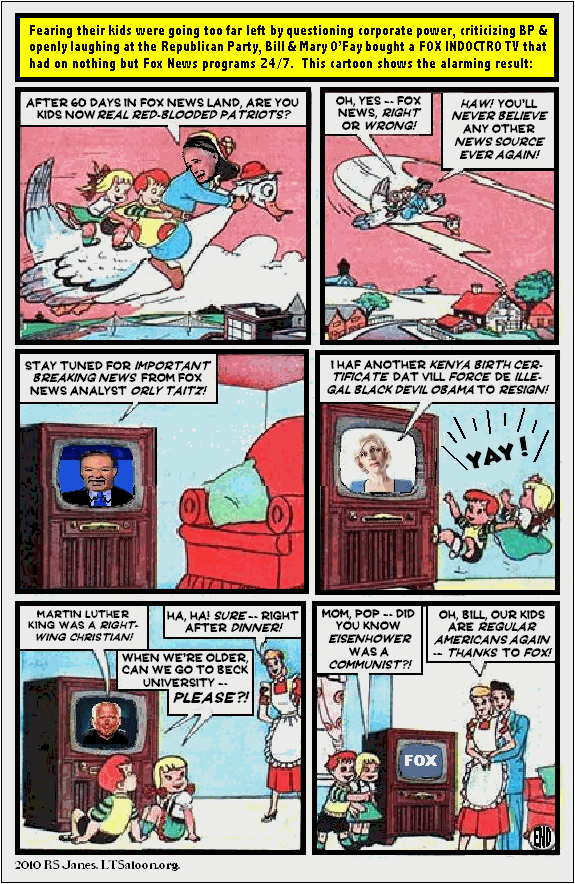
FOX Indoctro TV – The Alarming Cartoon Result

cartoon-fox-indoctro-tv-2

July 11, 2010

A new word: Oilcane

Filed under: Uncategorized — Greg in cheeseland @ 6:33 pm

Author’s note: This is kinda funny. According to the New York Times there is a new word in the English Language. I can now die of benzene, polycyclic aromatic hydrocarbons, 2-Butoxyethanol, Propylene Glycol and other volatile organic compounds knowing that I made a difference!

From the New York Times:

Oilcane
The combined effect of spilled oil and a hurricane.

Tropical storm Alex has prompted fears about the possible effects of a hurricane on the oil clean-up operation in the Gulf of Mexico, Gregory Patin wrote on Examiner:

According to Bloomberg, the mere possibility of a named storm entering the Gulf had Wall Street betting on a worst-case senario. On Friday, crude oil prices rose the most in four weeks on concern the first tropical storm of the hurricane season may head into the Gulf, disrupting both clean up efforts and oil production. …

Researchers at the Colorado State University hurricane forecast team, perhaps the most accurate in the nation, predict 18 storms. The team anticipates 10 hurricanes forming in the Atlantic basin between June 1 and Nov. 30. Five are expected to develop into major hurricanes (Saffir/Simpson category 3-4-5) with sustained winds of 111 mph or greater.

So, what does that mean for Gulf residents, besides the usual destroyed property and higher gas prices? How about a new word? Oilcane! And a new experience that makes the tar sheets washing up on beaches benign by comparison.

Patin directed readers to a post by senior meteorologist Alex Sosnowski on AccuWeather.com, who argued:

Depending on the approach of a tropical storm or hurricane, increasing winds and building, massive seas would first halt containment operations.

Rough seas would dislodge or destroy protective booms, rendering them useless as the storm draws closer.

Next, as the storm rolls through, high winds on the right flank of a hurricane making landfall would cause some oil to become airborne in blowing spray.

A storm surge could carry contaminants inland beyond bays, marshes and beaches to locations well inland.

Even a glancing blow from a hurricane passing to the west of the oil slick could be enough for winds and wave action to drive the goo nearby onshore, or to more distant fishing and recreation areas, perhaps in foreign waters.

Read the original article here: Madison Independent Examiner

July 10, 2010

Gulf residents, marine life: Specimens for a toxic science experiment

Filed under: Uncategorized — Greg in cheeseland @ 11:00 pm

Author’s note: The oil and the dispersants alone are toxic, but the combination may be worse. No wonder BP won’t allow clean up workers to speak to the press, or allow the press anywhere near the clean up operations.

Excerpt:
According to scientists and researchers, the wide use of dispersant chemicals on the oil in the Gulf may amount to a toxic science experiment because because so little is known about the health effects of oil mixed with dispersants.

What is known about the chemicals is frightening.

The Oil

The oil itself is highly toxic. Dr. Gina Soloman’s blog for the Natural Resources Defense Council (NRDC), describes the acute health effects of exposure to oil as including headaches, dizziness, nausea, vomiting, irritation of the eyes and throat and difficulty breathing. In addition, the off-shore burning of oil, one of the strategies being used to reduce the massive spill, could harm human health. Anywhere that oil can be smelled is a place where oil particles are being inhaled and that poses health hazards.

There are long-term health concerns as well. Even after the spill has been staunched, fish and shellfish may carry the contaminants in their bodies for decades. “Contaminants in oil can persist for years and accumulate in the food chain,” Dr. Solomon writes, “causing elevated cancer risks or neurological risks from exposure to heavy metals such as mercury.” In addition to long-term cancer risks, some of these chemicals have been linked to miscarriages and birth defects.

The Dispersants

Corexit 9500 and 9257 have been injected in the underwater gusher by BP and dropped from the air to disperse the oil. They have been used by BP in unprecedented quantities. As of June 7, already over 1.08 million gallons have been used in the Gulf.

According to Molly Rauch, MPH, writing for Physicians for Social Responsibility:

The dispersants do not make the oil go away, but they break it up into tiny blobs so that it is not as harmful to wildlife and so that it is more accessible to being broken down by bacteria. At least that’s the thinking behind what is turning out to be a massive, uncontrolled experiment in the use of these chemicals….These chemicals are poisons, used only in a grim calculation that their effects on the ecosystem can’t be worse than the effects of the unchecked oil spill. (Emphasis added).

Although two of the known hazardous chemical ingrediants of a dispersant are 2-Butoxyethanol and Propylene Glycol, others are unknown and listed as “proprietary” on the Material Safety Data Sheets (MSDS) published by Nalco, the manufacturer. Charlie Pajor, a senior manager at the Illinois-based company told the New York Times: “It’s like any other product. We developed them and we’re protecting our trade secret.”

The MSDS’s list both acute and chronic potential health effects on humans including, central nervous system effects, nausea, vomiting, anesthetic or narcotic effects, injury to red blood cells (hemolysis), kidney and liver damage, and may defat and dry the skin, leading to discomfort and dermatitis.

Toxicologists, however, are now saying that Corexit is much more harmful to human health and marine life than we’ve been told.

The Toxic Soup

While both the oil and dispersants alone are toxic, the two substances combined may be even more toxic. The chemical compounds in each do not negate each other or disappear, rather they combine into what can be called a toxic soup.

On July 9, Dr. Shaw stated on CNN:

Shrimpers [were] throwing their nets into water… [then] water from the nets splashed on [one's] skin. …[He experienced a] headache that lasted 3 weeks…heart palpitations…muscle spasms…bleeding from the rectum…And that’s what that Corexit does, it ruptures red blood cells, causes internal bleeding, and liver and kidney damage. …This stuff is so toxic combined… not the oil or dispersants alone. …Very, very toxic and goes right through skin. (See video here).

Similarly, marine biologist and toxicologist Dr. Chris Pincetich, who has an extensive background in testing the affects of chemicals on fish, says that Corexit disrupts cell membranes in all living organisms, including humans. He also explains that EPA testing of chemicals is woefully inadequate. (See video here).

Considering that all of the ingredients of Corexit are not known, that EPA toxicity testing is inadequate, and that no one knows what the health effects on humans are when exposed to oil combined with dispersants, what this amounts to is a huge toxic science experiment with all of the marine life in the Gulf and Gulf residents as the test subjects.

Read more, get links and videos here: Madison Independent Examiner – Gulf residents, marine life: Specimens for a toxic science experiment.

July 9, 2010

We are ALL pelicans: The harsh consequences of environmental pollution

Filed under: Uncategorized — Tags: , , — Jane Stillwater @ 2:23 pm

Last night I dreamed that I was interviewing Oscar the Grouch. But when I woke up, I discovered that it was only a leg cramp that had caused the dream. Do you know how to cure leg cramps? Here’s how. Use an exercise that physical therapists call “The clam shell”.

Assuming that this evil cramp is in your right leg, then lie down on your left side, thrust your right hip as far to the left as you can go, bend your right leg half-way, and then move your right knee up to the ceiling and down to the bed or floor a few times — like a clam shell opening and closing. Voila. End of cramp.

It’s the sideways motion of your leg that does it. The muscles get confused. They think that they are only spozed to move back and forth, not sideways.

And clams got me to thinking about pelicans and all that oil-spill mess in the Gulf. If someone doesn’t contain that spill soon, our oceans could become hopelessly polluted — and if the oceans lose their ability to breath oxygen into the atmosphere and our oceans die, then you and me will probably die too.

When our oceans’ inability to process oxygen is combined with our disappearing forests’ inability to process oxygen plus our reduced oxygen levels caused by car exhaust, air travel and war machines, then any fool can tell that we humans will soon be in big trouble — not to mention that nobody seems to notice the huge amounts of totally dangerous nuclear waste we are accumulating, along with enough piles, mounds and masses of plastic Coke bottles generated daily to be seen from the moon if they were all in one place.

Am I the only one alive today that notices this stuff?

Anyway, after I woke up from the Oscar the Grouch dream, I got to thinking about pelicans. You know, the ones all covered with oil; the ones with the look in their eyes that says, “What happened? What hit me? Help!” And that “greasy-pelican” look could pretty much become ours soon too, in a shorter amount of time than we would like — covered with pollution, wondering what the freak had happened to us and slowly dying.

Not only that but there are approximately six billion people on the planet right now and each one of us has added at least one plastic bottle per (week, day, month, check one) to the landfill — or what used to be our farmland. Dig into the ground almost anywhere 20 years from now and you won’t hit oil. You’ll hit plastic. And rusted-out old cars. And toxic chemical sludge. And nuclear waste. Unless something changes drastically in the very near future, in less time than we can imagine, we are all gonna be pelicans too.

PS: Actually, the human race does have one saving grace on the horizon — the end of oil. When we are out of oil in a few decades, at least there won’t be so much carbon dioxide released into the atmosphere any more. Who would have thought that being forced to go back to candlelight, horse-drawn buggies, caissons, cavalry and manual typewriters would be just the ticket to save the human race from extinction?

PPS: I was listening to progressive radio talk-show host Mike Malloy the other day and some right-winger commented that, “If only Ronald Reagan was alive today, he would have searched for an answer to the oil spill problem — and to all of our other problems too.” Dream on, wingnut. The only answers that Ronald Reagan ever searched for involved looking for newer and better and more corrupt ways to make him and his rich buddies even richer.

I’m not sure if I got Mike Malloy’s quote exactly right here or not — because I was too busy cleaning my apartment to take notes. Yes, after all these years I’ve finally found a house-cleaning system that works for me! Every weekday between 6 pm and 8 pm, I listen to Malloy’s radio talk-show on Green 960 AM and clean house. Then I get so angry at all the major Republican neo-con screw-ups he tells us about that I take my anger out on my apartment and actually manage to get stuff cleaned up and/or thrown out.

Next I’m going to take on gardening, another task that I hate, and garden from noon to 3 pm every day while listening to Randy Rhodes — taking my anger out on the weeds.

Currently every kind of right-winger you can imagine is busy telling me that if only America puts Republicans back in office, then they will clean up America’s mess. Not! Republicans and their various rich-dude allies are the very ones who made most of this freaking mess in the first place — as well as getting all us poor sweet victims of their nefarious plans to be all scrambling at each others’ throats while they, like the Beagle Boys, clean out the mint.

It’s like the old “Hair of the dog that bit you” theory I guess — that if we only drink more of the Republican neo-con Kool-Aid that got us drunk in the first place, our hangover from the last batch won’t hurt quite so badly? How naive do they think that we are?

If we really want to clean house in Washington, perhaps we should do it while listening to Mike Malloy!

July 8, 2010

BP turning Gulf Coast into corporate police states

Filed under: Uncategorized — Greg in cheeseland @ 7:45 am

Author’s note: I recently spoke with a friend who used to work with the New York Times and I was told, “don’t go there and get the hell out of FL…ASAP.” Not sure what she meant by that…

Excerpt:
Reporters and photographers are reporting numerous incidents where they have been prohibited from approaching areas where oil has fouled Gulf beaches and have been prevented from taking photos or gathering enough information to publish reports.

BP clean up workers have been forbidden from talking to the press. The incidents of BP officials and the U.S. Coast Guard barring reporters from recording the effects of the disaster have been recorded in mainstream media, and date as far back as the third week of May.

Who owns the Gulf coast, the American people or BP? One may be tempted to answer that the federal government owns it. Keep in mind, however, that all federal officials – elected, appointed or hired – supposedly work for the taxpayers that pay their salaries.

Apparently that is no longer the case in the corporatocracy known as the United States of America, because federal officials, police agencies and the U.S. Coast Guard seem to have pledged their allegiance to BP rather than the U.S. constitution and the American people.

At least the Obama administration has managed to plug one thing: the flow of information related to the oil disaster from the beaches of Gulf states. The ability to document a disaster, particularly through images, is key to focusing the nation’s attention on it, and the resulting clean-up efforts. Yet Americans are being denied this information.

Take, for example, this recent report that has been all-but buried in the sand: (get the links here).

While that may have been a long account of a relatively short-lived incident, it is indicative of the intimidation that journalists, especially free-lancers that are not part of the corporate media establishment, have been subjected to in the Gulf states since the BP oil disaster. I recently spoke with a friend who writes for a major publication and was told, “don’t even go there.” So,instead, I’ll just post a link to the top 20 photos that BP and the federal government do not want you to see here.

Normally, with a story like this, I would be lamenting the lack of corporate media coverage, but many mainstream news sources have reported that journalists and photographers are being denied access to the Gulf coast by BP, local law enforcement and federal officials.

Obviously, the U.S. Government and BP share the same interest – preventing the public from knowing the magnitude of the spill and the inadequacy of the clean-up efforts. What could possibly be happening in the Gulf of Mexico right now that is so drastic that BP and the federal government is willing to destroy our rights in order to protect their secrets?

The police state behavior of this, however, may be even more significant. In effect, BP, a British corporation, is now controlling American law enforcement officials and a branch of the U.S. military. It is impossible to know where government actions end and corporate actions begin because the line between them no longer exists.

Your rights as a free citizen have been obliterated in the past 10 years, and what is happening in the Gulf is a good example of that. America is on the verge of becoming a fascist corporatocracy that answers to the financial interests of huge corporations – at the expense of the freedoms and tax dollars of the people.

Read more, get links and video here: Madison Independent Examiner – BP turning Gulf Coast into corporate police states

July 4, 2010

Islamic Terrorists: Creating a Frankenstein monster

Filed under: Uncategorized — Tags: , , , , , , — Jane Stillwater @ 12:51 pm

Back in approximately 1528, when the very first black man was snatched from a village in Africa and shoved onto a slave ship, somehow a ball got rolling that has consequences even down to this day. That single act of brutality began a long, slow process that eventually resulted in the proliferation of violence and crime in America’s inner cities four centuries later.

Cruelty always gets the ball rolling, gets the party started — but in a bad way.

So. What cruelties, exactly, got the Islamic terrorist ball rolling? Was it when Mohammad (PBUH) wrote the Qu’ran? And if it was, then why aren’t most American Muslims now terrorists too? And why don’t their teenagers run in violent gangs like so many Christian teenagers here do? Dearborn, in Michigan, for instance, has a very large Muslim population and the largest mosque in America. So why aren’t the Muslims of Dearborn all terrorists? Obviously it’s not their religion per se that is turning Muslims into terrorists. So it must be something else.

“But what could it be?” you might ask. I think you could get an answer to that question from any competent psychologist since Freud. Terrorists aren’t shaped by their religion. And terrorist aren’t just born that way either. Terrorists are created by their childhood experiences. Terrorists are created by cruelty.

Take Afghanistan for instance — a country that’s known for its terrorists. Those terrorists didn’t just suddenly spring full-grown from the head of Zeus. No, they were systematically created by centuries of systematic cruelty.

First the Brits brutally invaded Afghanistan. Then the Russians brutally invaded Afghanistan. Then the Americans brutally invaded Afghanistan. Brutality. Cruelty. Injustice. And now we wonder why that poor country is overrun with terrorists? Duh.

And then there’s Iraq. The Brits systematically destroyed democracy in Iraq. And Americans gave Iraq three gifts that kept on giving: Saddam Hussein, Shock and Awe and Abu Ghraib. In Iraq, Brits, Americans and their European allies created a Frankenstein monster — step by step, day by day.

And during approximately the last 90 years, Palestine has been systematically invaded by various forms of Europeans — not to mention the Crusades. Whether it was Lord Balfour, King Richard or David Ben Gurion who invaded the Holy Land, these Europeans have all worked really hard to create Frankenstein monsters in Palestine too — and America to this day still keeps footing these invaders’ bills.

Sure, a few Palestinians have hijacked some airplanes in protest — but Europeans and Americans have hijacked their entire region.

And remember how British Petroleum and the CIA worked in tandem to violently destroy democracy in Iran and to replace it with the West’s own bloody Shah, king of torture?

Face it, guys. The whole Middle East has been under the jackboots of American and European colonialism, imperialism and cruelty for a long, long, long time. And, keeping that thought in mind, you might also consider the suggestion that perhaps we are looking at Islamic terrorists from the wrong perspective. Perhaps if it hadn’t been for the calming and civilizing influences of Islam, all these Frankenstein monsters that the West has cheerfully created in the Middle East might have turned out even worse.

Consider what happened when Europe and America unleashed their cruelty on the Congo, Rwanda and Zimbabwe. At least the Middle East didn’t turn out as badly as all that. Maybe Islam actually helped give Muslims something hopeful to cling to in the face of all that Shock and Awe.

PS: As you may have already noticed unless you’re brain-dead or watch Fox News, the military-corporatist structure that brought us Rwanda, Afghanistan and Abu Ghraib is still in the driver’s seat in Washington now and still happily doing all its usual cruel nasty stuff. Which can only make me wonder — as our democracy dies and so does our economy — what kind of Frankenstein monsters are they happily creating here at home too?

PPS: And what, exactly, is the justification for all this cruelty? Apparently the justification is greed. Geez Louise! Just how many extra yachts do you guys need? Is it true that Dick Cheney is the world’s first trillionaire? And has all this endless supply of big bucks flowing seamlessly into his coffers from faulty oil platforms and endless wars made HIM happy? Yeah right.

PPPS: I am assuming that you do know that the oil spill in the Gulf could be worse than anything even the most fiendish terrorists could ever have done to us, right?

I just read somewhere that there are billions of teeny-tiny little crustaceans in our oceans and they are using all that excess carbon dioxide in sea water (which would otherwise be harmful to us) to build their sweet little teeny-tiny shells. And if they didn’t build these shells, there would be too much carbon dioxide in the oceans, it would be released into the air and we would all die. So if the oil spill kills off all these cute little guys in the same way that it is now killing off dolphins and turtles, we will be doomed.

To quote Wilbur the talking pig, “I don’t wanna die!”

And speaking of pigs at county fairs, me and my family are going off to the Alameda County Fair next Wednesday. Joe and Ashley are going to buy me a chicken — to eat all the snails in my postage-stamp-sized yard so that I can plant a victory garden. I’ll let you know how that goes.

July 3, 2010

67 Americans who will not be celebrating the 4th of July

Filed under: Uncategorized — Greg in cheeseland @ 7:58 am

Author’s note: Seems like the wars are not getting much attention, but each of these 67 families deserve that.

Excerpt:
67 Americans will not be celebrating the 4th of July, and 67 families will grieve a loved one this holiday, because of the wars in Afghanistan and Iraq.

The pentagon has released the names of 67 Americans who have died in June, bringing the total U.S. casualties in Iraq and Afghanistan this year to 203.

While Americans are understandably concerned with the disaster in the Gulf of Mexico, a stagnant economy and a plethora of other issues, the two ongoing wars seem to get little attention in the media. The members of the armed services who put their lives on the line and make the ultimate sacrifice seem to be getting less and less attention.

It is a safe assumption that most Americans who have been paying attention to the news put forth by the corporate media do not how many service members died in June, and even fewer know their names. This article may be long, but that is because the list of young Americans who have made the ultimate sacrifice to their country is long. The list will get longer until Americans demand an end to these wars. If you cannot take the time to read each name, then ask yourself if it was worth it for each one of these young people to give their lives.

To whom it may concern, here are their names and some details about each one of them: (see link)

Many Americans voted for a leader that promised to bring an end to the wars, yet nothing substantive has been done toward that end. Meanwhile, the corporate media buries news about the wars, leaving these brave young men and women to die with a hardly a mention to their names. They deserve more. We as a nation deserve more.

Our young people are not fighting a foreign enemy bent on invading our homeland, they are occupying the homeland of other nations and are paying for that with their lives. Meanwhile our homeland and our economy is being destroyed by the very corporations that reap the profits from these wars and from the reckless spending of our tax dollars that finance the wars. BP, for instance, holds more than $2 billion in annual US defense contracts and continues to be the premiere provider of fuel to the world’s largest consumer of oil and gas: the pentagon.

Perhaps the best way to support our troops is to bring them home. And the best way to protect America may be to protect our borders, our shorelines and our economy by focusing our resources on solutions to the problems that we have here in the US, not occupying and rebuilding other nations halfway across the globe.

Read more here: Madison Independent Examiner – 67 Americans who will not be celebrating the 4th of July

July 2, 2010

Arnieville: Cutting CA home care will cost us six times as much

Filed under: Uncategorized — Tags: , , , — Jane Stillwater @ 1:26 pm

If you walk or drive down Adeline Street in south Berkeley right now, you will see dozens of disabled people camping out on the median strip in the middle of the street. “We call this place Arnieville,” I was told. That, however, is not breaking news. That story has already been covered on TV.

People on crutches and in wheelchairs are out in force, protesting a whole bunch of huge new state budget cuts to their home-care provider’s salaries. These care providers allow disabled Californians to live on their own. The disabled protesters have been camping out in protest against these radical and life-endangering cuts since June 22, 2010. But that’s not hot news either.

The disabled campers are holding a press conference over the Fourth of July weekend. Is that going to be big news too? Probably not. Nor is it breaking news that someone just dropped off a homemade blackberry pie for the disabled protesters to eat as they camped. But it was good news for me! My two-year-old granddaughter Mena got a slice of the pie — and she also got a ride on one disabled camper’s wheelchair. Mena thought that was totally cool. But then she didn’t have to be confined to a wheelchair and totally dependent on her home care provider seven days a week for the rest of her life.

Disabled people are the most courageous people I know.

However, one disabled person disagreed with me regarding wheelchairs. “We are not ‘confined’ to our wheelchairs per se,” she said. “Actually, our wheelchairs liberate us and give us freedom. Without them, we would be forced to spend our lives just lying in bed.” I don’t think that Mena would like that either. And using one’s wheelchair to give oneself freedom is a truly appropriate way to celebrate Independence on the Fourth of July — far more appropriate than Washington’s many attempts in the last ten years to disable the United States Constitution.

Perhaps it is breaking news that people in wheelchairs and with other disabilities are building a life-sized paper mache statue of Arnold Schwarzenegger right here on Adeline Street today. Or perhaps not.

It might be sort of newsworthy that a few dozen disabled people are now out here struggling to keep their protest going, to take care of their camp and to take care of themselves when most of them are physically incapacitated — up to 80 or 90%. Please! If there are any civic-minded young and strong volunteers out there who can come down and lend a hand at keeping the camp running, you will be totally welcome.

“Can I help do the dishes or something?” I asked one of the organizers, a woman with an obvious degenerative disease. “Oh, that’s okay,” she replied, perhaps worried that I didn’t look much stronger or energetic than she did.

No, it’s not news that I’m not as able to do the heavy lifting needed at Arnieville as the Governator himself would be. “Hey Arnie! Come down here and help us pitch some tents!”

What really was the breaking hot news at Arnieville today was when my neighbor Jana Ovebo drove up in her wheelchair and said, “If the state eliminates our home care workers as planned, then I will have to be institutionalized — just in order to survive.” Jana has had rheumatoid arthritis since she was nine years old and can barely even move by herself. And yet she still manages to run her own business, Disability, Resources, Exchange & Mobility Supports (DREAMS). And she still manages to come down to Arnieville and protest.

“The cost of my care if I was institutionalized,” stated Jana, “would be SIX TIMES more than what the state is now paying for home care providers.” Without her home-care workers, Jana would either have to be immediately institutionalized or be allowed to die on the street. Either choice sucks eggs.

And one home-care provider involved in the protest just informed me that, “It’s not only our salaries that are at stake: The Terminator is also trying to eliminate 40% of state funding for the entire disabilities program. This would knock thousands of people off the program all together. Then there’s the cuts to Medi-Cal, Adult Day Health and other services that keep seniors and people with disabilities in their communities.” And these people would also have to be institutionalized at six times the cost of what we are paying now? Yikes!

Hurray for Arnieville! That’s the GOOD news.

An Interview We’d Like To See

Filed under: Uncategorized — Peregrin @ 4:42 am

I pity the fool who tries to cut Mr. T’s mike!

Actually, no, I don't.

July 1, 2010

As hurricane Alex whips up Gulf waters, BP disaster planning does not account for storms

Filed under: Uncategorized — Greg in cheeseland @ 10:16 pm

Author’s note: Duhhoooh!

Excerpt:
Hurricane Alex has whipped up waves as high as 7 feet that are washing oil over booms on the Gulf coast and driving oily water ashore and into marshes.

BP’s plan on file with the federal government for dealing with an oil spill in the Gulf, meanwhile, takes into account the potential impact on walruses, but not the potential impact of a hurricane or even a tropical storm.

One small problem with that – there are no walruses in the Gulf of Mexico, but tropical storms and hurricanes occur there regularily.

How stupid could BP and the federal officials at the Minerals and Management Service (MMS) who accepted this plan be? Are they on crack? That’s a rhetorical question, as investigations have shown that MMS officials have accepted bribes from oil company lobbyists that included cocaine, meth and hookers, when they were not watching porn on their taxpayer-financed PCs.

As Hurricane Alex moved through the Gulf on Wednesday, Rep. Ed Markey (D-MA) issued a sharply-worded press release and fired off a letter to BP asking why it had overlooked the possibility of contending with a spill in the middle of a hurricane or storm.

Here is a point that Markey made in his press release:

The BP plan had walruses in the Gulf, but no hurricanes, said Rep. Markey….Walruses haven’t been in the Gulf in a few million years, while a hurricane is just a few hundred miles from the spill site right now. This is yet another example of BP serial complacency.

At an Energy and Environment Subcommittee hearing on June 15th, Chairman Markey and others revealed that the major oil companies had response plans that were 90 percent identical, and included references to walruses in the Gulf of Mexico, and emergency contact information for long-deceased experts. The CEOs of the major oil companies testifying admitted that their response plans contained significant flaws, calling them an “embarrassment.”

The BP response plan uses the word “weather” in several instances, but never does so in an analysis of extreme weather that could markedly affect response capabilities.

There are six more questions that Markey asked BP America CEO Lamar McKay. Hit this link and read them.

This is not just another example of BP’s utter failure to prepare for real contingencies such as a disaster like this, it is also a failure of the federal government to properly regulate the industry. Prepared for walruses, but not a storm in the Gulf!?! One does not have to be a meteorologist to know that major storms regularily hit the Gulf of Mexico and that any spill response plan ought to take that into account. Yet no one in the U.S. government required BP to plan for that, and of course, BP did not do that on their own.

That is so ludicrous that even a fiction writer would think it has no plausibility, yet it is a sad reality for millions of Gulf residents.

Read more and get links here: Madison Independent Examiner – As hurricane Alex whips up Gulf waters, BP disaster planning does not account for storms

« Newer PostsOlder Posts »

Powered by WordPress