November 19, 2007
November 18, 2007
McCain Says That He Would Reject Secret Service Protection as President
Michael D. Shear, The Washington Post, November 18, 2007
John McCain often says on the campaign trail that he wants to take on the system in Washington. Usually, he’s talking about congressional spending and pork-barrel projects. But he also wants to challenge the system of protection that forces presidents to live life in a bubble.
“It’s my intention, if we win this nomination, to reject Secret Service,” he said during one of his many conversations with reporters on his Straight Talk Express this weekend. “Why do I need it?”
He adds: “The day that the Secret Service can assure me that if we’re driving in the motorcade and there’s a guy in a rooftop with a rifle, that they can stop that guy, then I’ll say fine. But the day they tell me, ‘well, we can’t guarantee it,’ then fine, I’ll take my chances.”
McCain rejected Secret Service protection in 2000, after winning the New Hampshire primary. But he wants to go further, rejecting the massive security apparatus should he become president.
“It’s the inconvenience,” McCain said. “It’s the inconvenience it causes people. It’s a waste of the taxpayers money. It’s just everything I don’t like.”
David Penner: Zombie Nation

David Penner, CounterPunch, November 2, 2007
As The Office of the Vice President continues to scheme and plot for war with Iran, which would also likely correspond with martial law at home, the American worker continues to sink deeper and deeper into a horrifying abyss of economic, moral, and spiritual slavery. Even during the worst days of the Depression, never was the American worker more crushed, more beaten, more defeated. Never was he more atomized, more alienated, more alone.
Listen to what people are talking about on TV, on the streets, and in restaurants, and it is clear the American people are pathologically disconnected from reality. This disconnection from reality is particularly pronounced in both the media and academia, where the most critical issues of our time are either completely ignored, or drowned in a barrage of hyperbole and euphemistic blather. It is as if, due to so many decades of brainwashing, Americans are no longer capable of reason, no longer capable of independent thought.
It is also becoming harder and harder to obtain a good paying job without compromising oneself ideologically due to the destruction of the public sphere. The role that the military and prison industrial complexes play in providing employment, and the role played by the media and the education system in indoctrination, pose grave questions about whether constitutional democracy and American capitalism can continue to coexist, or whether the elite will sever the marriage entirely ushering in a military form of government. The unprecedented domination of work in American society, and the cult of placing one’s career above and beyond all other considerations, has dehumanized the American people and turned them into collaborators.
In the education system, where universities are increasingly owned lock, stock and barrel by corporations (many universities are corporations), free market dogma reigns unchallenged. The education system, together with the unprecedented power of the mass media, have ushered in a brave new world where Newspeak reigns over the enlightenment, madness over empiricism, and barbarism over reason.
E. J. Dionne: And It’s One, Two, Three… What Are We Fighting For?

E.J. Dionne, The Washington Post, November 18, 2007
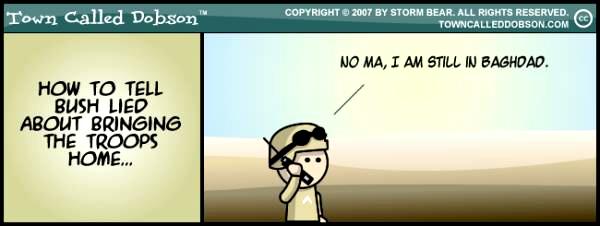
WASHINGTON- It’s time that we subject the Iraq war to the same cost-benefit analysis that we are called upon to impose on other government endeavors. We are supposed to repeal or revise domestic programs that don’t work. Shouldn’t a troubled war policy be treated the same way?
Driving the current debate is the assumption that we can’t afford to withdraw our troops from Iraq because of the chaos that will ensue. The idea seems to be that somehow-against the evidence of the last four and a half years-good things will happen if we just keep the war going.
This upside-down debate puts the burden of proof in the wrong place. We should be asking whether keeping our forces in Iraq over an extended period is worth the cost in lives, injuries, money, lost opportunities and the strain on our military. How will a prolonged stay in Iraq enhance our security? Is Iraq distracting us from foreign policy questions that will matter far more to our national interest in the long run?
President Bush regularly brags about the accomplishments of the troop surge. It’s certainly true that our troops have performed superbly. Let’s be happy that, albeit at great cost, the overall levels of violence in Iraq have dropped and that al-Qaida in Iraq is weaker today than it was some months ago.
The question to which the administration has no answer is how this military success will produce a decent outcome down the road.
Comments Off

Sesame Street Is Dangerous
This article truly made me sad. We seem to have become a society where a children’s show is threatening to our children because it shows a little reality, but our government isn’t threatening even though its reality is waging illegal wars and using torture. We are really on the brink of insanity as a nation.
Link